
Advocacy and policy
NSHA speaks for Subsisters before local, state, and federal bodies. Its aim is zoning, water, land-use, and food rules that let households provide for themselves without penalty.
Why it mattersAn official resource of the National Subsistence and Homesteading Association, a nonprofit organization. NSHA is not a U.S. government agency.
National Subsistence and Homesteading Association
NSHA holds that a household providing most of what it needs, in common cause with other households that do the same, is the soundest way for most Americans to live. It was ordinary life a century ago. NSHA works to make it attainable again through education, land, funding, and a decentralized network of Subsisters.
About NSHA
The National Subsistence and Homesteading Association exists to make subsistence and homesteading lifestyles understandable, attainable, and sustainable for ordinary Americans. NSHA advocates for the people who grow, raise, preserve, and build for themselves, and works to remove the barriers of land, knowledge, and money that keep others from joining them.
NSHA welcomes every step toward self-provision, from a first garden bed onward. Its purpose, though, is larger than encouraging a pastime. The association holds that near-full subsistence is the optimal way of life for the majority of Americans: a household that produces most of what it needs and meets the rest through exchange with other subsisting households, next door or across the country. That arrangement was common and unremarkable a century ago. NSHA treats it as a destination to be reached in steps, not a hobby to be kept on the side.
NSHA speaks for Subsisters before local, state, and federal bodies. Its aim is zoning, water, land-use, and food rules that let households provide for themselves without penalty.
Why it mattersNSHA is preparing plain-language guides and will host hands-on workshops. A planned apprenticeship program will place learners on working operations so skills pass directly from one Subsister to the next.
Open the learning libraryNSHA plans to acquire property and run a working subsistence operation. The site will serve as a school, a demonstration farm, and proof that the model works.
About the model operationNSHA will help Subsisters find and apply for existing grant and loan programs. It will also pursue funding as an organization and plans to pass a portion of it through to local nodes (small, self-organizing Subsister groups) and individual projects.
Funding and grantsLearn
Two related ideas, one destination: a household that meets its own needs with its own hands, its own land, and its community.
Subsistence means a household producing what it needs to live: food, water, heat, shelter, and everyday goods. In full form, the household supplies nearly all of this itself and obtains the rest by exchange with other subsisting households, near or far. That is the destination. A family that grows half its vegetables, keeps a few laying hens, and heats with wood it cut itself is on the way there, and so is a household that puts up a season of produce from a shared garden plot. NSHA counts every one of those steps as subsistence practice, and holds that the destination, not the first step, is the point.
Subsistence is not the same as living “off the grid,” and it is not a rejection of modern life or of other people. It has always depended on neighbors, and NSHA encourages reliance on other Subsisters as part of the model rather than a departure from it. Many practitioners hold jobs and use modern tools while they move toward the destination. Subsistence is also different from farming as a business, where the goal is to sell a crop at a profit. The goal of subsistence is to meet your own needs first, buy only what you must, and build a margin of safety that no supply chain or paycheck can take away.
Homesteading is the practice of organizing home life around subsistence. It brings together growing food, keeping animals, preserving the harvest, making and repairing things, and caring for land and water. Historically the word referred to settling and working a parcel of land. Today it describes a way of living more than a piece of property.
Homesteading happens at many scales. An apartment resident who grows herbs on a balcony, ferments vegetables, and mends clothing is homesteading. So is a suburban family that replaces a lawn with raised beds and a few fruit trees. So is a household on rural acreage with a barn, a woodlot, and livestock. The scale changes. The habits do not. NSHA’s work is to help any household that wants to move up that scale do so.
Who Subsisters are
A Subsister is a member of the National Subsistence and Homesteading Association. Subsisters are at every stage, from those planting a first tomato to those stewarding working land. What unites them is a shared commitment: to move their own household toward providing for itself, and to stand ready to help other households do the same. Self-reliance and mutual support are not opposites. A Subsister practices both, and understands that reliance on other Subsisters, whether down the road or in another state, is how subsistence has always worked.
You need to own land to start.
Most subsistence skills can be learned in a rented apartment, a community garden plot, or a borrowed backyard.
Subsistence means going without.
Subsistence households eat better, not worse. The aim is to depend less on what must be bought, with modern tools and knowledge in hand, not to do without.
Subsistence means going it alone.
Subsistence has always depended on neighbors. NSHA encourages reliance on other Subsisters, next door or across the country, as part of the model.
You have to do it all at once.
Subsistence is a destination reached in steps. Most Subsisters move toward it over years, often while holding a job, trading a little more each season for a little less bought.
The public interest
Four reasons a household’s ability to provide for itself is a public concern, not a private hobby.
Long supply chains are efficient but fragile. A household that can grow, store, and preserve part of its own food is less exposed when shelves are empty or prices climb.
Food, energy, and housing take a large share of household budgets. Every meal grown, every jar preserved, and every repair made at home is money that stays in the household.
The federal programs that once helped ordinary Americans settle and work land ended decades ago. Today's agricultural support is built mainly for commercial producers, so households that simply want to feed themselves have few doors to knock on. NSHA exists to open some.
A century ago, gardening, canning, butchering, mending, and building were ordinary household skills, because daily life required them. Much of that knowledge was never written down, and it disappears when the people who hold it are gone.
Precedent
For most of the nation’s history, a household that fed, housed, and supplied itself was the ordinary case, and the federal government treated that way of life as a public good worth land, money, and printed instruction. NSHA’s position rests on that record.
Signed by President Lincoln, the Act offered 160 acres of public land to any adult who would live on it, improve it, and work it for five years. About 1.6 million homesteads were granted before the program closed, covering roughly 270 million acres, close to a tenth of the land area of the United States. The last claim was proved in Alaska in 1988.
Source: National Archives
The Department of Agriculture began publishing Farmers’ Bulletins: short, free, plain-language guides mailed to any household that asked. They taught Americans to garden, keep poultry, preserve food, and plan a small holding. By 1934 the series had passed 1,700 titles.
Source: National Agricultural Library
The 1920 census was the first in which more Americans lived in towns and cities than in the countryside. Even then, about three in ten Americans still lived on farms, and household production of food, fuel, and clothing remained ordinary in town and country alike.
Source: U.S. Census Bureau
In the depth of the Depression, Congress set aside $25 million under the National Industrial Recovery Act to build planned communities where families could combine part-time wage work with land enough to feed themselves. The Department of the Interior’s Division of Subsistence Homesteads started about three dozen such communities, beginning with Arthurdale, West Virginia. “Subsistence homestead” was, for a time, the language of federal policy.
Source: National Archives
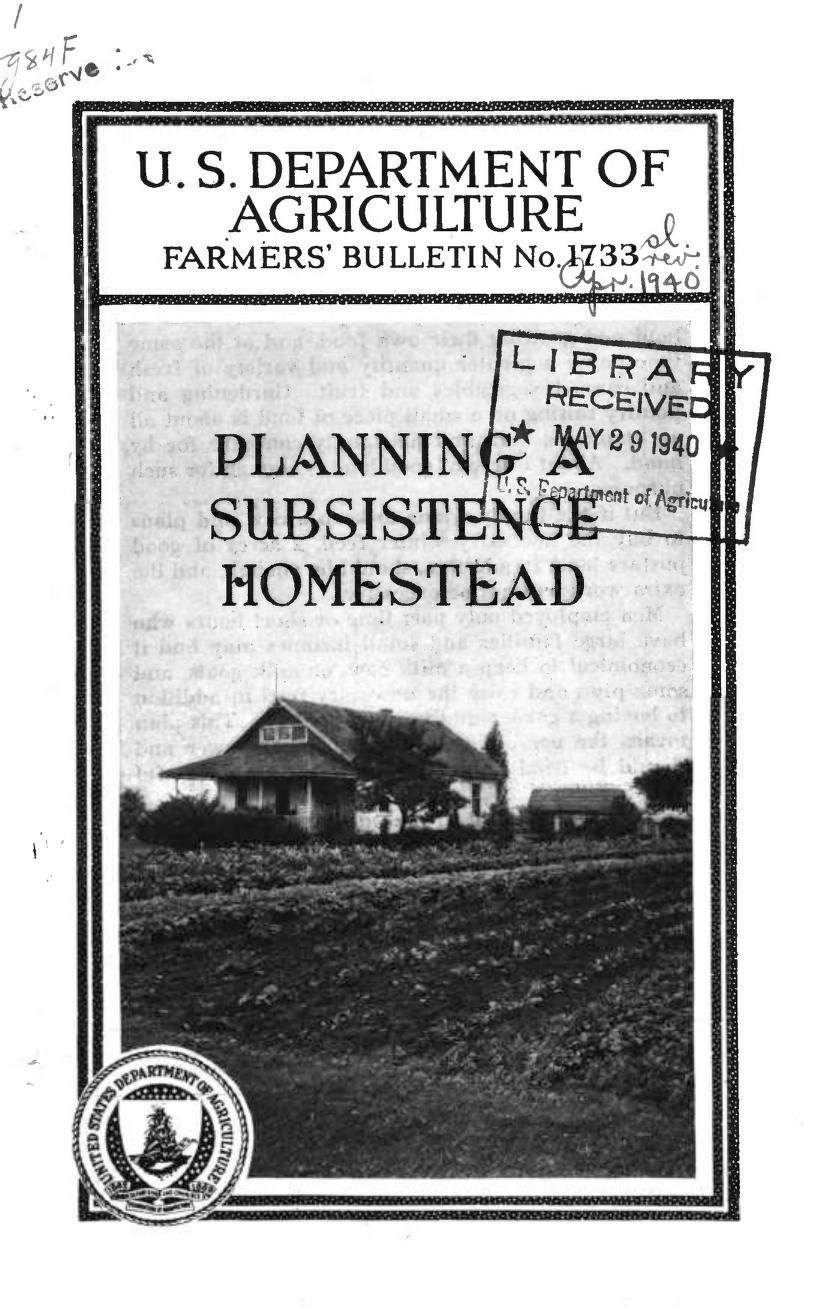
The Department of Agriculture published Planning a Subsistence Homestead, a step-by-step guide for a working family to live on about one acre. It is featured below.
During the Second World War the government asked households to grow their own vegetables so that commercial produce could go to the troops. By commonly cited wartime estimates, Americans planted some 20 million Victory Gardens, which supplied a substantial share of the fresh vegetables the country ate.
Source: National Agricultural Library
Featured document
Written by Walter W. Wilcox and published by the U.S. Department of Agriculture, this bulletin told an ordinary working family exactly how to live on a small piece of land: about one acre for a garden and poultry, two more if they wanted to keep a cow. It assumed that the head of the household held a job in town. In plain terms, it is the federal government’s own handbook for the way of life NSHA advocates.
“Many families with small incomes can lower their living costs by living on a small piece of land and growing their own food, and at the same time enjoy a greater quantity and variety of fresh and canned vegetables and fruit. Gardening and poultry raising on a small piece of land is about all an employed man and his family can care for by hand. About 1 acre of good land is enough for such purposes.”
The two plans below are reproduced from the bulletin. Each lays out a one-acre lot, 100 by 440 feet, with a house, a vegetable garden, small fruit, an orchard, and a poultry run, sized to feed a family of five. The bulletin judged this “all that a man who is employed elsewhere during the growing season can care for properly by hand with the help of his family.”
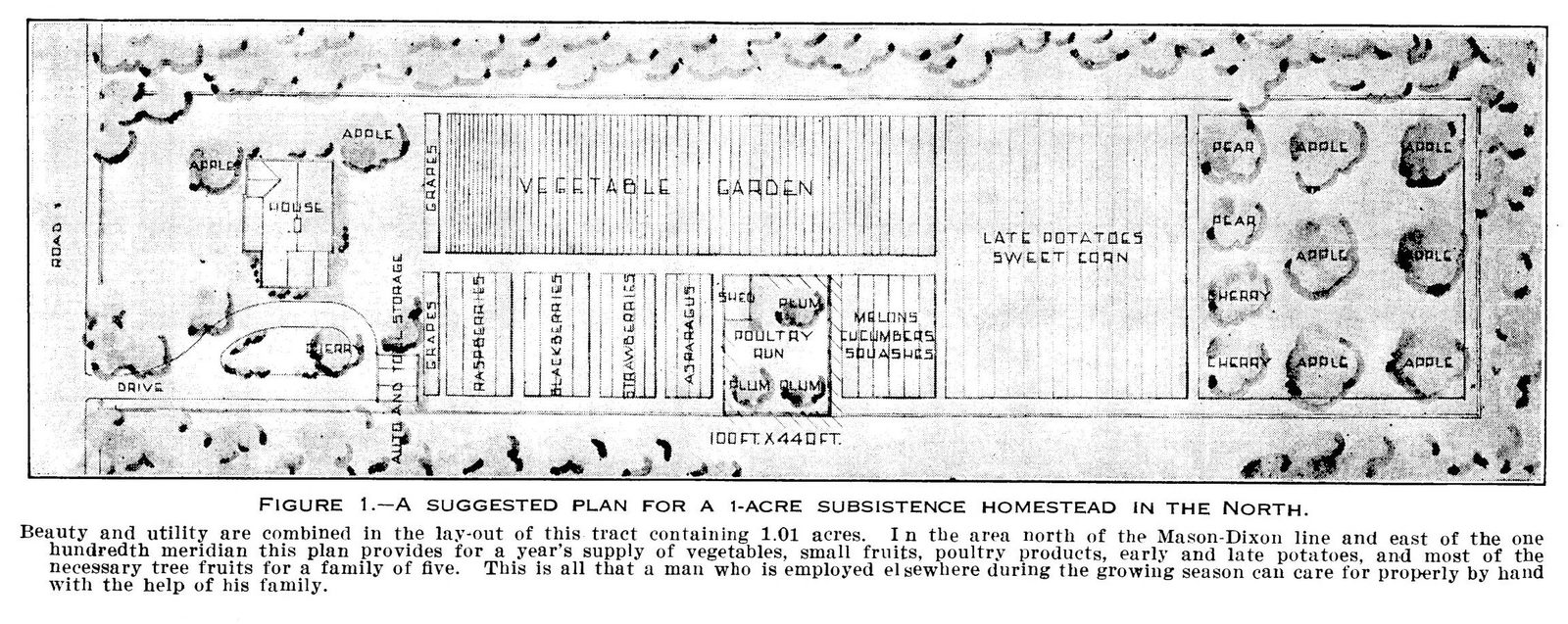
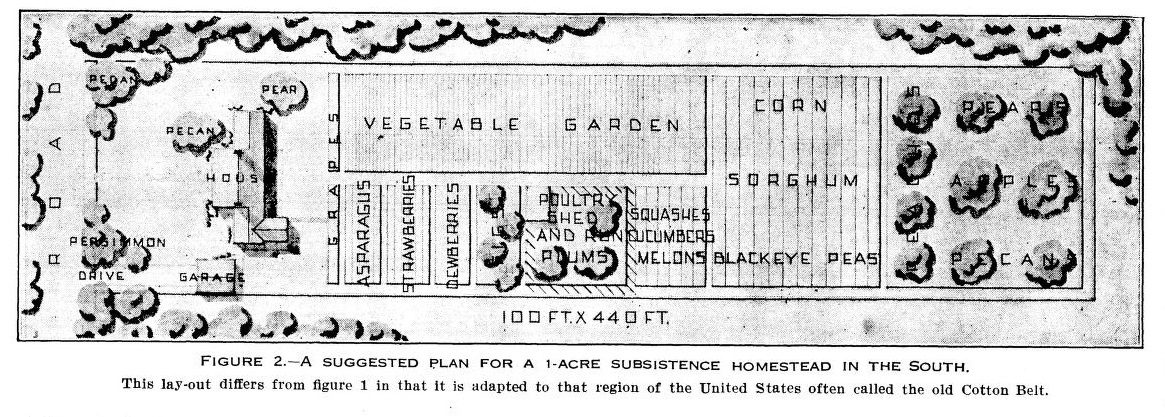
Images: U.S. Department of Agriculture, Farmers’ Bulletin No. 1733, via the National Agricultural Library’s Small Agriculture exhibit. Works of the United States government, in the public domain.
A century ago, a household that produced most of what it consumed was not a curiosity. It was the common case, and public policy backed it with land, instruction, and planned communities. NSHA’s position is that the same arrangement, carried out with modern tools and knowledge and bound together by a decentralized network of Subsisters, remains the soundest way for most American households to live. The programs that once supported it have lapsed. NSHA exists to take up that work.
The Subsister pathway
Each step builds on the one before. The destination is a household that provides nearly all of what it needs, and every step toward it can be taken where you already live.
Understand the basics before you spend money on tools or land.
Start small, bring in a real harvest, and learn from what fails.
Carry a harvest past its season so it feeds you through the year.
Add capacity and connect with people who can help.
Manage land for the long term and pass your knowledge on.
Self-education library
Six self-education tracks, taken at your own pace. Each one begins with three plain-language topics.
All library material is free to read. No membership required.
How to grow vegetables, fruit, and staple crops at any scale, from containers to acreage.
How to keep what you grow safe and edible for months.
How households collect, store, and use water and energy wisely.
How to keep small livestock responsibly and humanely.
How to find, afford, and lawfully use land.
How to build the relationships that make a household resilient.
Placeholder. The guides listed above are being written. Until the library is published, each guide link leads to this note.
Glossary
Words you will see on this site and hear at NSHA events.
Events
Events will be organized by regional chapters, with virtual sessions open to Subsisters anywhere in the country. The first season is being planned.
An informal gathering for current and prospective Subsisters to meet neighbors, trade seed and surplus, and hear what the regional chapter is working on.
Reserve a seat (registration link to come)A hands-on session covering water-bath and pressure canning, fermentation, and dry storage, taught by experienced Subsisters with equipment provided.
Register for the workshop (registration link to come)A working clinic on finding land, reading a listing, understanding easements and water rights (both explained in the glossary), and walking through the loan and grant programs that may apply to you.
Sign up for the clinic (registration link to come)An open meeting where NSHA leadership reports on advocacy work, answers questions, and takes input from Subsisters on priorities for the coming season.
Join the town hall (registration link to come)Placeholder. Dates, locations, and registration links will be published here when the first season of events is confirmed.
No event near you? Regional chapters will host most in-person events. If your area does not have a chapter, see the network section to learn how to start a node.
Membership
Membership supports NSHA's advocacy, education, and land programs, and connects you to the Subsister network. Dues have not been finalized. All tiers will use a sliding scale so cost is never the reason someone stays out.
Dues TBD Sliding scale · details to come
One person who is practicing, learning, or planning a subsistence or homesteading life, whether on acreage, in a suburb, or in an apartment.
Dues TBD Sliding scale · details to come
Two or more people who live under one roof or work one homestead together, so that everyone in the household is a Subsister under one membership.
Dues TBD Sliding scale · details to come
Established homesteads, farms, cooperatives, churches, community gardens, local businesses, and other groups that want to host or anchor a node.
Placeholder. Membership forms will open when dues are finalized. Until then, the buttons above lead to this note.
The NSHA learning library, self-study paths, and public workshops are open to everyone. Start there, and join when you are ready.
The network
A decentralized network has no headquarters that everything depends on. It is made of many small, local groups, called nodes, that operate on their own and cooperate with one another. Each node knows its own soil, climate, laws, and neighbors. The nodes of one region together form a chapter, which organizes regional events and carries the region's voice within the association. Skills pass directly from one Subsister to the next. Seed, tools, and labor move between households without waiting on permission from anyone far away.
\1\nDistance is not a barrier. A Subsister in one state can mentor, trade seed with, or buy surplus from a Subsister in another, and nodes are encouraged to link with nodes far away as readily as with the one in the next county. Relying on other subsisting households, near or far, is not a compromise of self-reliance. It is the form self-reliance has always taken.
Each node is a household, farm, mentor, or shared resource. Darker nodes are anchor sites: farms and households with room to host apprentices. Nodes support one another directly. There is no headquarters that can fail.
A small group of Subsisters in one area agrees to meet on a regular schedule, in person or by call.
The node lists what its members have and what they need: skills, tools, seed, land, storage, labor, and time.
Members trade, lend, teach, and work alongside one another according to the inventory, using simple agreements the node sets for itself.
The node registers in the NSHA directory, reports what it is learning, and draws on other nodes and the association when it needs more than it has.
Once published, the NSHA node directory will list existing nodes by area, each with a coordinator to contact.
Search the node directory (link to come)Gather a few interested households, read the node starter guide, and register the node with NSHA.
Read the node starter guide (link to come)If you are unsure where to begin, request a call with a regional chapter volunteer who can walk you through the first steps.
Request a call (link to come)Placeholder. The node directory, the starter guide, and the request-a-call form are in preparation and will be linked here.
NSHA's role. NSHA supports the network with shared standards, a public node directory (in preparation), connection to grants and funding passthrough (planned), and insurance and legal guidance (planned), while leaving day-to-day decisions with each node.
Land and apprenticeship
NSHA plans to acquire property and operate a working subsistence homestead on it. The operation will produce food and materials for the people who work it, and it will also serve as a school. Apprentices will live and work on site for a season under experienced Subsisters. Visitors will be able to see raised beds, orchards, livestock, a root cellar, water systems, and energy systems in daily use. The goal is a place that proves the model works and sends trained Subsisters home to start their own.
Status: Property search and fundraising in progress. Location and timeline TBD.
Season-long, hands-on placements for Subsisters who want to learn by doing, with room and board on site and a clear curriculum.
Side-by-side plots and systems that show methods, costs, and yields honestly, so visitors can judge what will work at home.
Regular public days when anyone can walk the operation, ask questions, and take part in a task.
Funding and grants
Land, tools, livestock, and time all cost money, and the lack of it is one of the most common reasons a household does not start.
Public programs exist that can help, but they are scattered across agencies, written in technical language, and rarely explained to the people who need them most. NSHA treats funding as a core program, not an afterthought. NSHA will pursue grants as an organization, help individual Subsisters find and apply for what already exists, and raise donations so that the work does not depend on any single source.
NSHA will apply for foundation, agricultural, conservation, and community development grants at the organizational level. A portion of funds raised is planned to pass through to regional nodes and to individual Subsister projects through a simple application process. Details will be published as funding is secured.
Passthrough grants (details to come)Several public programs may be relevant to Subsisters, depending on individual circumstances. They are listed below. NSHA is preparing plain-language guides to these programs and plans to host land and financing clinics to help Subsisters work through applications.
Read the program guides (link to come)Gifts from individuals, businesses, and foundations will fund NSHA's advocacy, education, and land programs. Sponsors may support a specific workshop, clinic, or apprenticeship. Details on how to give will be posted once the association's nonprofit status is finalized.
Support NSHA (giving page to come)Placeholder. The passthrough program details, program guides, and giving page will be linked here once each is finalized.
Named in general terms only. Eligibility and terms are set by each agency; follow the agency links for current details.
NSHA provides information and assistance only. NSHA does not administer federal programs. Eligibility and terms are set by each agency, and NSHA does not guarantee eligibility for, or award of, any grant, loan, or program.
Get involved
Membership, events, and the network are open to households at any scale, from a windowsill to acreage. The destination is the same for all of them.